The state of SEO: embracing generative engine optimisation
Big thanks to the great work done by RankMath in putting together this recent video update on the state of search. Please see my summary of the content below and what you can do now to adapt to the changes.
We use RankMath Pro on all websites we develop with business owners who want to maximise their website customer activity.
The world of Search Engine Optimisation (SEO) is undergoing a rapid transformation, leading some to suggest that "Seo is dead"—though it is more accurately described as "evolving". The old way of approaching SEO is "dying faster than ever", replaced by concepts like Generative Engine Optimisation and Answer Engine Optimisation. This significant shift is largely attributed to the rise of AI-driven search experiences, including tools like Perplexity, You.com, and ChatGPT's own browsing capabilities.
These platforms do not work like classic search engines, which serve lists of blue links; instead, they aim to give the user an answer right there and then. They focus on conversational queries, offer useful comparisons, and provide quick insights, efficiently leading users through the entire buyer's journey very quickly compared to traditional searches, where multiple websites must be visited to get answers. Consequently, traffic originating from large language models (LLMs) is expected to become more valuable than traffic coming from traditional search engines.
Here are the critical shifts that website owners, publishers, and businesses must address to adapt and thrive:
1. The disappearance of the 10 blue links
The traditional structure of search engine results pages (SERPs) is fundamentally changing. Based on research analysing over 100 search queries on Google, the classic expectation of "10 Blue Links" on the first page is largely outdated. In the observed research, only six search results included 10 Blue Links, while the remainder typically had between seven and eight blue links. You will rarely see nine.
Furthermore, the types of results appearing on page one have diversified dramatically.
- Forum and discussion sites: Reddit was present as a Blue Link 82% of the time, and Quora accompanied Reddit 12% of the time. Discussion and forum sections appeared in the search results 78% of the time overall.
- Video content: YouTube videos appeared as a search result in 22% of the queries analysed.
This means the shrinking number of blue links that content creators are trying to rank for is now effectively reduced to about six or seven.
2. Shift focus from ranking to citation
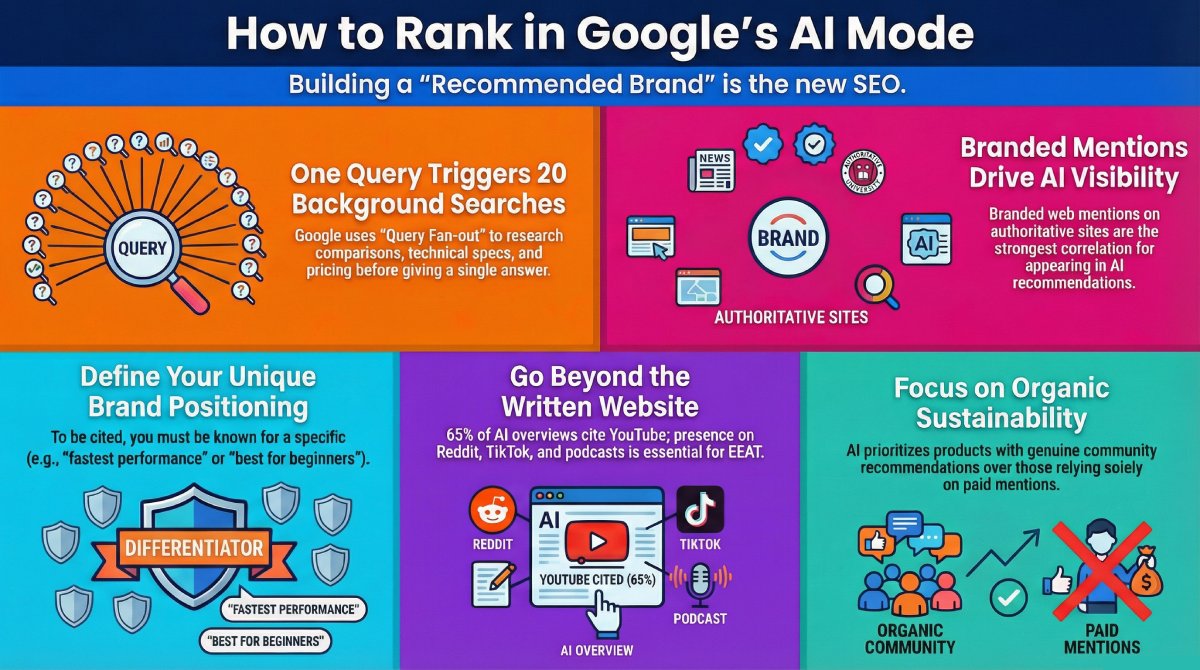
The most important strategic pivot is shifting focus from merely ranking high on the first page to writing content sections that AI Overviews will cite. AI Overviews appeared in 64% of the queries analysed.
A key finding is that AI Overviews do not exclusively cite the top-ranking content. In fact, only one to three cited sources analysed were from page one of the search query. The rest of the cited sources frequently came from page two, page three, and sometimes even page six.
This provides a levelling of the playing field, presenting an opportunity for newer websites. 69% of the AI Overviews cited sources from websites with a domain rating of 40 and below. Additionally, the AI Overviews frequently cited YouTube videos (65% of the time) and Quora/Reddit (15% of the time).
Brands and businesses should optimise their content specifically for LLMs. One recommended method is to add important links to a file named llms.txt on their site.
3. Purpose-driven content and the decline of affiliate-only blogs
The future of search is purpose-driven. Websites that exist "solely to promote other people's products," such as affiliate-only blogs providing only information, are already seeing significant traffic declines.
Every piece of content created should lead somewhere. This destination could be a product page, a booking form, a free tool, a newsletter sign-up, or a community invitation.
The data support this commercial focus: 31% of the top 10 AI Overview citations did not include any personal or content-only blogs. The vast majority of cited websites were commercial blogs selling services or products.
Content creators who previously ran content-only blogs must pivot. Strategies include:
- Building a personal brand.
- Pivoting to selling something themselves or through affiliate links clearly connected to a commercial intent.
- Diversifying platforms to YouTube, Instagram, TikTok, and focusing on community building (e.g., Substack, Patreon).
4. Optimising for hyper-specific, multimodal searches
The trend toward voice and multimodal searches is growing rapidly. Consumers are increasingly using voice assistants weekly: 21% use them to find information, while 20% use them to complete an action like ordering something.
Due to the rise of AI and voice search, people are asking questions that are "hyper-related to their situation". Modern queries are highly specific, including details about location, time, and current availability.
- Instead of "Vegan Pizza Restaurant near me," the query is now: "Where can I get vegan pizza near Serangoon that is open right now?".
- Instead of general product search, visual search via tools like Google Lens allows users to snap a photo and find where to buy that specific product.
Businesses are missing out if they are not optimised for this specificity and intent. This requires including specific details, such as landmarks, building names, and places, within your Google Business Profile and on your website.
For product-based businesses, optimisation should include optimising images for SEO (reducing file size, adding alt tags, and adding schema) and ensuring photos are taken from every possible angle. Additionally, businesses should allocate a budget for advertising, as shopping ads are appearing in AI Overviews and AI Mode.
5. Traditional SEO is still the foundation
Even with the dominance of LLMs and AI Overviews, traditional SEO cannot be ignored because LLMs currently still gather information from the top results of traditional search engines. For example, when asking a question on platforms like Perplexity, they still go through relevant websites ranking for related search queries before providing answers to users.
To ensure your site is seen on AI Overviews and by LLMs, traditional factors remain crucial:
- EEAT: Adherence to Experience, Expertise, Authoritativeness, and Trustworthiness is more important than ever.
- Technical health: Site structure, internal linking, and keyword research remain foundational.
Finally, while AI tools are quickly being adopted by businesses (a joint survey discovered a 71% adoption rate), quality is paramount. Google focuses on the quality of the content, regardless of how it was produced. If you use AI tools to quickly write first drafts, human oversight is necessary to add unique insights and angles to ensure the content stands out and successfully demonstrates EEAT.